blender-modeler
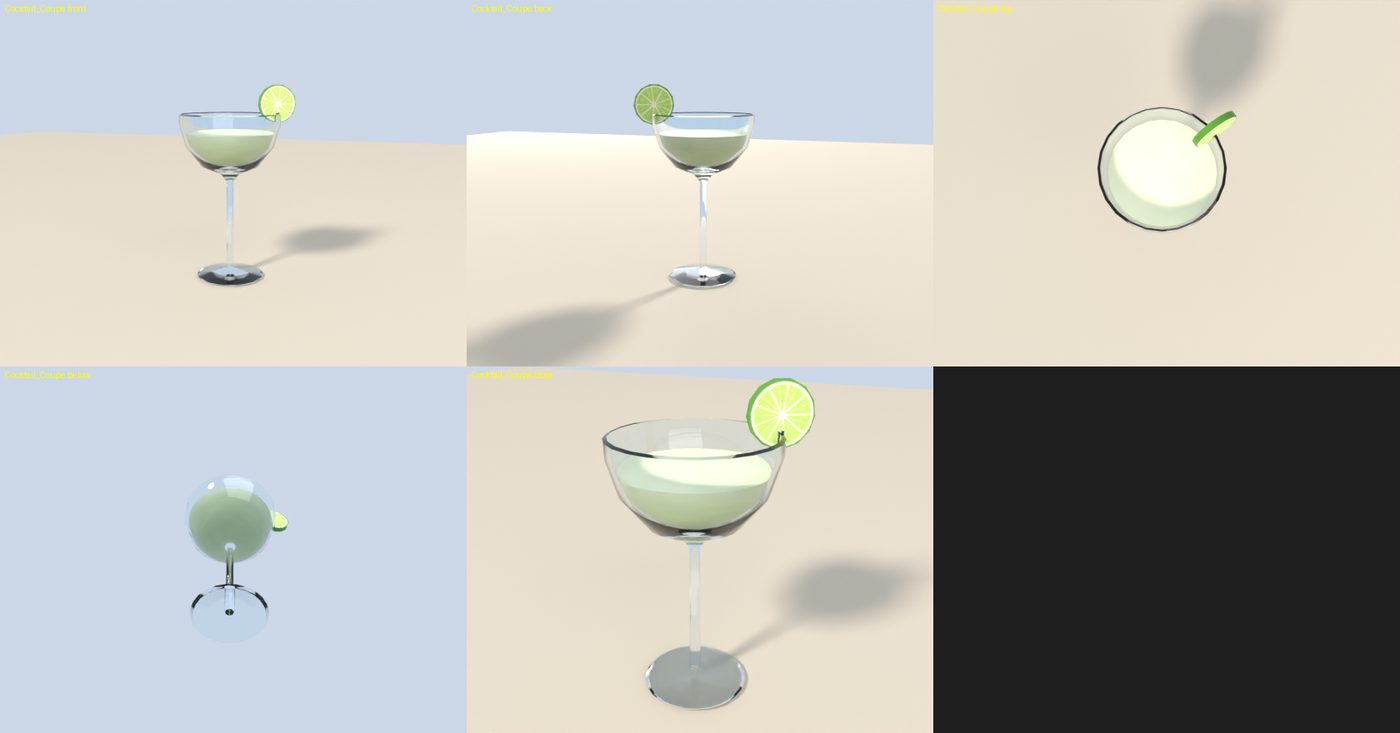
The modeller's own check renders of a cocktail glass for Crescent Lagoon: a rim with thickness, an inside, the drink as its own surface. Unreviewed at this point: the model gate comes next.
The blender-modeler makes game-ready, low-poly models in headless Blender (Blender run without a window). It models hard-surface and turned objects and building shells, and it makes draped cloth by simulation.
When it runs
On demand from a C.1 build-out pass, when nothing existing fits. The orchestrator decides each asset's route with one test: does the object need sculpting?
| Route | Objects | Who |
|---|---|---|
| model | hard-surface and turned objects: glasses, cups, bottles, vases, lamps, furniture frames, tools, signs, rings, hooks, taut rope and chain, structures, shells | this agent |
| cloth-sim | draped cloth: throws, blankets, towels, curtains, tablecloths, flags, nets, hammock cloth | this agent, by simulation only |
| find, then generate | anything that needs sculpting: animals, figures, statues, pillows, cushions, plush, rocks, corals, food, plants up close, knots | asset-finder, then image-to-3D |
It also handles avatar exports to Blender, with the armature preserved.
What you give it
This agent has no numbered PASS list. The brief carries:
- the task and its target size, from the pass plan,
- the picked concept image, for object type and silhouette,
- the locked boards, for palette, materials and style,
WORLD.md, which it reads before modelling,- for a building shell: the approved greybox data and the opening list.
Budgets it works to
| Asset class | Target triangles | Materials |
|---|---|---|
| Small prop (mug, book, tool) | 300 to 1500 | 1 |
| Medium prop (chair, lamp, crate) | 1500 to 5000 | 1 (2 max) |
| Furniture or appliance | 4000 to 15000 | 1 to 2 |
| Hero, large structure, detailed model | 15k to 50k, with LODs | 1 to 3, atlased |
These are working targets, not hard caps. Textures are 512 to 2048 px, never 4K on a small prop.
What it returns
- One model per FBX file, with the front on Unity +Z.
- A sidecar
<stem>.model.jsonbeside every export:front,real_size_m,joints. See gates. Joint_<name>empties wherever the model attaches to something in the world.- The
.blendsource and the textures. - A report: triangle and material counts, measured size, the coplanar pair count, expected import scale, whether a second UV set exists.
- The line "unreviewed: awaiting asset-reviewer" for every file.
Before handing over, it runs the gate's own tool on the export and looks at the close-ups:
python .omp/scripts/tool.py blender --script .omp/skills/asset-import/scripts/model_gate.py -- --model <file> --out <dir>
Rules it works by
- Furniture is real-world size. Shells, decor and outdoor pieces are real size ×0.8.
- One material where at all possible. Atlas instead of splitting.
- No coplanar faces. Two overlapping faces on one plane shimmer in Unity.
- Building shells are one merged, welded mesh per floor or room cluster. No overlapping faces, no gaps.
- Flames are never meshes. It leaves an empty named
FlameSocket. - Fix the model, never the number. No scaling, hiding or re-declaring a part to pass a check.
What it never does
- Never models anything that needs sculpting. Handed one, it says "routing error" and stops.
- Never shapes cloth by hand from planes or boxes.
- Never opens or drives the interactive Blender window.
- Never edits Unity scenes or copies files into
Assets/. - Never hunts for assets. A task handed to it wants new geometry.
- Never writes a custom tree generator. Trees follow the
lowpoly-tree-generationskill.
Who judges its work: asset-reviewer. MINOR FIXES or NEEDS WORK is its next task, and every re-export is a new file for the gate.
Source: agents/blender-modeler.md.