Hard rules
The kit has 13 hard rules. They hold in every world, for the whole session, for every agent.
The numbers here match RULES.md, the file the agents read. Details live in AGENTS.md.
A hard rule is not a default. You change a default for one world by telling the agent. A hard rule stays unless you change the kit itself. Defaults are on World defaults.
| No. | Rule in short |
|---|---|
| 1 | Read the project's own AGENTS.md before editing that project |
| 2 | Colliders: none on small props, big furniture solid, trunks always, no barriers |
| 3 | No seat station unless you ask |
| 4 | The reviewers are the gate |
| 5 | Drive the open Unity Editor through the editor bridge, never the files |
| 6 | Bake reflection probes right after every lighting bake |
| 7 | Git repos are local backups, never pushed |
| 8 | People are 1.4 m tall, shells are ×0.8, furniture is real size |
| 9 | After a confirmed 3D blockout, no more 2D plan rounds |
| 10 | No complex objects modelled in Unity, shells come from Blender |
| 11 | Test bakes are quick, at most 10 minutes, one at a time |
| 12 | Your decisions and picked art are binding |
| 13 | Every world has world sounds, switchable at spawn |
1. Read the project's own notes first
Rule. Before an agent edits a world project, it reads that project's AGENTS.md.
It also reads DESIGN.md and TASKS.md when they exist.
Why. The agent starts in the workspace root. Per-project files do not load from there on their own. Without this step the agent works without the project's own facts.
2. Colliders
A collider is the invisible shape that stops a player. The rule decides what is solid.
| Thing | Collider |
|---|---|
| Chairs, stools, couches, armchairs, coffee, side and bedside tables, decor, clutter | None. Players walk through them |
| Dining, kitchen and other big tables, counters, kitchen islands, bars, cabinets, sideboards, dressers, wardrobes, bookcases, appliance-sized pieces | One always-on box named SolidCollider, over the footprint, floor to top surface |
| Beds, couches, lie-on furniture | One top-surface box named LieDownCollider, off by default |
| Stairs | One smooth rotated ramp box per flight, never one box per tread |
| Every tree trunk, prop and pillar roots included | One capsule fitted to the visible trunk |
| Walk surfaces, building walls, rocks | Solid |
| Fences, railings, low walls | None |
| World edge, shore, coast, sea | No invisible walls, gates or wading walls |
More parts of the same rule:
- A collider goes only where the player must not pass. One
BoxCollideris preferred. - No
MeshCollideron anything players walk on. - Anything made from a Unity primitive loses its auto-added collider.
- The world's single lie-down toggle switches all
LieDownColliderboxes on. An Udon script does it. - A pickup you asked for keeps its own tight collider.
- Every building players can see is enterable from the path that leads to it.
- Jumping is on in every world. One local UdonSharp script sets
SetJumpImpulse(3). VRChat's default is 0.
Why. The kit gives a reason for each part:
- Big furniture is solid so players cannot walk through it and pickups rest on it.
- Lie-down colliders are for players without full-body tracking. Full-body players leave them off.
- Without barriers players may walk into water, step off edges and jump fences. The respawn height catches falls.
- A stair ramp is smooth to walk. Per-tread boxes are not.
3. No seat station unless you ask
Rule. A station is the VRChat component that seats a player (VRC_Station or VRCStation).
The agent never adds one to a chair, sofa, bench, stool, bed, jacuzzi or prop. It strips stations
from imported prefabs and never puts a removed one back.
Why. It is the kit owner's preference, not a performance tradeoff. When you do ask for seats,
the agent records it in the world's WORLD.md.
4. The reviewers are the gate
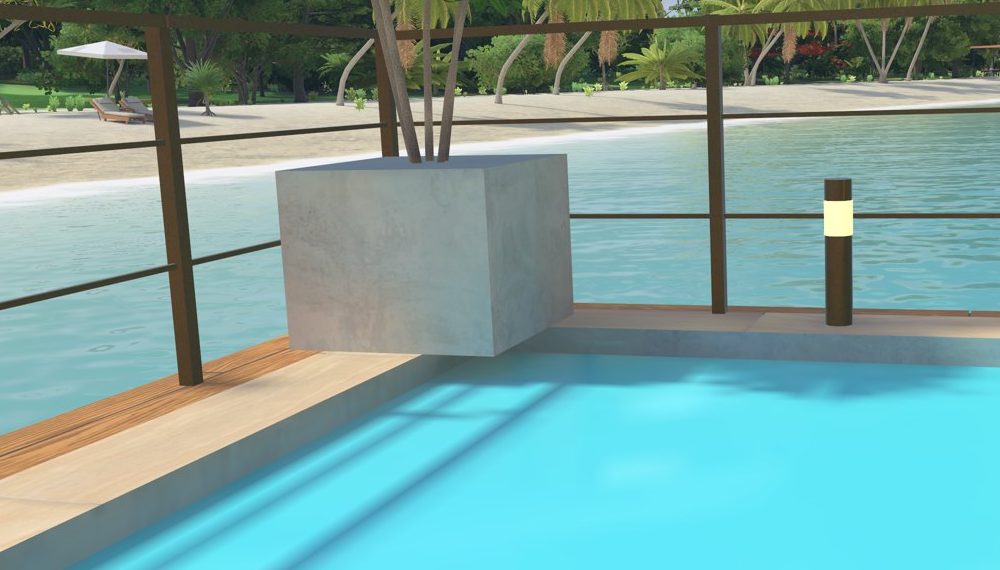
A planter hanging over a pool edge, found by the world's owner in game. A review of that state would have had to catch it.
Rule. Nothing modelled, built, generated, placed, textured, lit or made interactive is done until the matching reviewer returns SHIP IT. SHIP IT means no blocker, no should-fix finding and a score of 8 or higher. The builder's own screenshots and numbers do not count.
The rule in parts:
- Each gate has its reviewer:
asset-reviewerfor every model before import or placement,layout-reviewer,dressing-reviewerandfinal-reviewerfor their stages,material-reviewerfor surfaces before and after the bake,playtest-reviewerfor runtime behaviour. - Reviewers rerun the measured checks (
PropGate) themselves. They never accept logs. - NEEDS WORK or MINOR FIXES is the agent's next task list, not a report to pass on to you.
- One exception: early shell layouts and style images are accepted by your pick. The reviewer only ranks them.
- Small and hurried work counts too: quick placements, tweaks, effects, pickups.
- A state without SHIP IT on its current commit is called unreviewed in every report. "Saved" or "build-ready" never means reviewed.
- The agent does not stop or call a world ready while anything is unreviewed or failed. If you stop the work, it lists the open items by name.
- A world is ready for upload only with
final-reviewerFINAL andplaytest-reviewerUPLOAD GATE SHIP IT on the same commit. - Every defect you find becomes a permanent case in the findings ledger. It is shot again in every review round.
- Done needs a looked-at close-up of that exact thing. Nothing is scaled, hidden, buried, disabled or re-shaded to satisfy a check.
Why. Work was once handed over as ready while half of it had never been reviewed or had failed its review. A builder's own screenshots and audits do not replace an independent look.
How verdicts, scores and the ledger work: Review gates.
5. Drive the open editor through the bridge
Rule. The editor bridge is the tool that lets an agent act inside the running Unity Editor.
The agent uses it for every scene change and never edits an open scene's file by hand.
Scripted hierarchy edits need MarkSceneDirty before saving. After any script change the agent
reads the console and checks for error CS before it goes on.
Why. The Editor keeps the scene in memory and overwrites the file on save, so a hand edit is lost.
Without MarkSceneDirty, a parenting or renaming edit may not persist.
A compile error can silently cancel play mode and block every other agent.
6. Reflection probes right after every bake
Rule. A lighting bake computes the light and stores it in textures called lightmaps. A reflection probe is a stored picture of the surroundings that shiny surfaces reflect. After every lighting bake the agent bakes the reflection probes at once.
Why. A lightmap bake makes the old probes wrong, and no brightness number catches it.
Probes capture only renderers flagged ReflectionProbeStatic. That is a different flag from
ContributeGI, so it is easy to miss.
7. Git repos are local backups
Rule. The world projects' git repos are local backups. Agents never push them.
The agent commits a checkpoint after a significant chunk of work. git add can take minutes,
so it runs in the background. History is pruned only when you ask.
Images, video and raw captures are not tracked. The exceptions are Design/picks/, Design/lock/,
Pictures/ and a project's own product textures.
Why. The kit treats these repos as local backups only: checkpoints of the work, never a way to publish it.
8. Scale
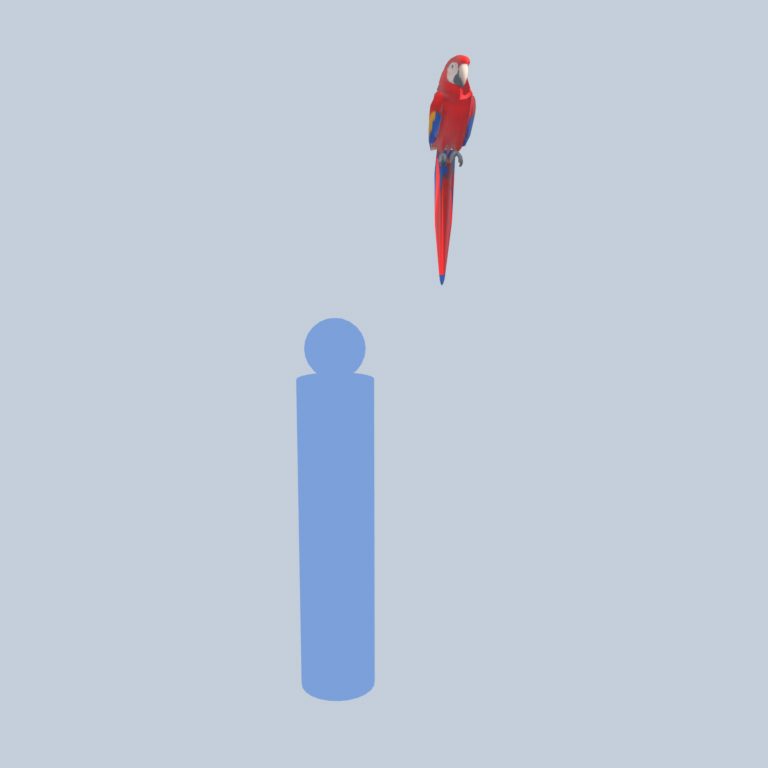
Every model is checked beside a 1.4 m person. Here a parrot at real size.
Rule. People are 1.4 m tall, with the eye at 1.3 m, in all worlds.
| What | Size |
|---|---|
| Shells (walls, floors, ceilings) and outdoor features | ×0.8 of real-world size |
| Furniture: seats, tables, beds, counters, cabinets, and the spacing between them | ×1.0, real-world size (seat about 0.45 m, table about 0.75 m) |
| Collision minimums | Never shrink: 2.3 m clear height, 2.1 m doors, 2.0 m paths, 0.91 m stairs |
Every scale figure, camera and brief uses the 1.4 m person.
Why. The groups the kit builds for play small avatars. A shell built for a full-size adult felt empty to them. Scaled-down furniture felt off in two worlds and was scaled back up. The collision minimums stay because VRChat's player collision does not shrink with the avatar.
9. No 2D plan rounds after a confirmed blockout
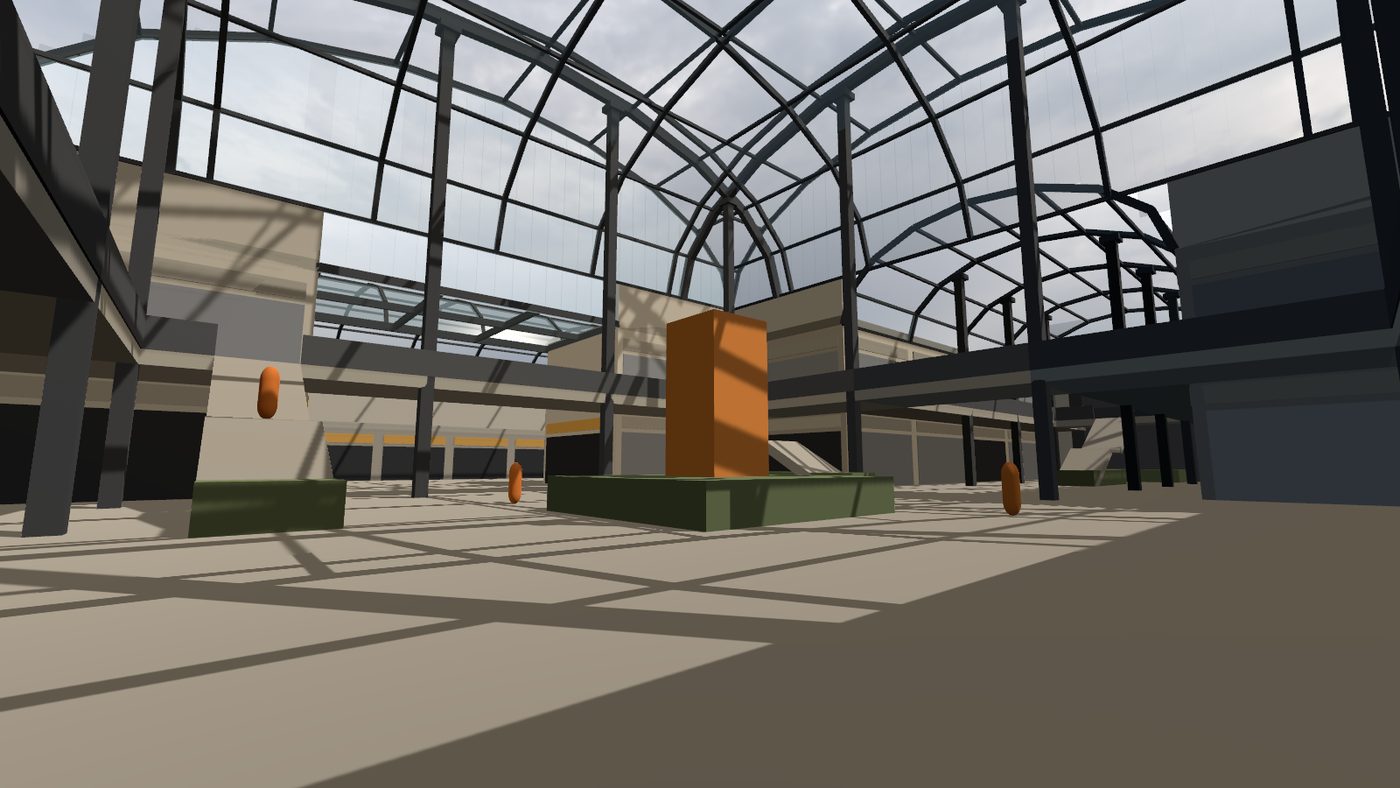
A shell blockout shown from eye height. Changes after your confirmation happen here, in 3D.
Rule. A blockout is the rough 3D model of the world's shapes. Once you confirm one, the agent never goes back to 2D plan rounds. Changes to a confirmed shell or greybox are made in 3D on the scene, shown from eye height and reviewed there. Plan data is updated from the scene.
Furniture is never planned in 2D or as greybox placeholders. It is placed in 3D during build-out and recorded afterwards.
Why. The confirmed 3D scene is the reference. The plan follows the scene, not the other way round.
10. No complex objects modelled in Unity

A fruit bowl built by a script inside Unity, as the owner saw it in game.
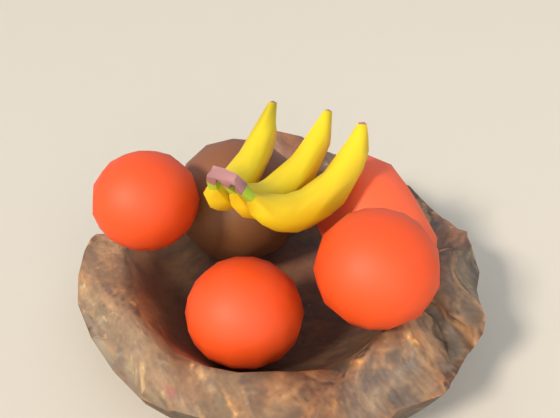
Its replacement: a sourced model, imported as a prefab.
Rule. Geometry made inside Unity, from primitives or from script-generated meshes, is for boxes only: plinths, quays, beams, square legs, stair treads and landings, small box trims, greybox massing.
- "Box" means the finished object is one plain box. A switch post, a sign, a lamp, furniture or a roofed post is assembled from several boxes, so it is a complex object.
- Building shells (walls, floors, ceilings, roofs, soffits, slabs, window reveals) are always modelled in Blender as merged, welded meshes with no overlapping blocks, then imported.
- Every other shape comes in as an imported prefab made to match the picked concept art.
- Each asset gets a route before work starts: find, model, cloth-sim or generate. The one test is
"does it need sculpting?".
asset-findersearches first on every route. - A faceted lathe, tube or lattice built in Unity is a blocker in review.
Why. Overlapping boxes leave seams and blotchy baked shadows. Objects stacked from primitives look crude up close, and a library, a modeller and a generator are there to do better.
11. Test bakes are quick, one at a time
Rule. Every test, iteration, fix-loop or review-round bake uses the QUICK preset: lowest samples, half texel density, bounces equal to final. It is cancelled if it runs past 10 minutes of wall time. Then the agent shrinks the scope and starts again. Re-baking is fine. Only the final bake you ask for may be slow.
Only one bake runs on the machine at a time. Before any bake the agent runs:
Exit code 1 means busy: another agent holds the lock, a Bakery tracer process is running, the GPU is at 60 % or more over 10 s, or 50 % or more of the VRAM is in use. The agent then does other work and retries later. It releases the gate the moment the bake finishes, fails or is cancelled.
Why. Draft bakes of 37 to 76 minutes once ran five times in one overnight fix loop. A quick bake answers the same question in minutes, and equal bounces keep its brightness trustworthy. Several agents share one GPU, so the gate keeps two bakes from starting together. It checks memory as well as load, because a job can fill the VRAM at low utilization.
12. Your decisions and picked art are binding

A concept image the owner picked.
The build made to match it, after a fix round. Work in progress: this state is unreviewed.
Rule. The agent records your decisions and picked art, feeds them to every helper agent, and never
overrides them. Each project keeps a decision database, STEER.jsonl, and a generated digest, DECISIONS.md.
- A recorded decision beats workspace defaults, skill defaults and briefs. A task that contradicts one stops and comes back to you.
- The orchestrator is the main agent you talk to. It records every new decision in your exact
words before it acts, with
python .omp/scripts/steer.py --project <project> addorpick. pickcopies art you liked toDesign/picks/.pick --rejectcopies art you disliked toDesign/picks/rejected/.- Only an explicit like is a pick. Only an explicit dislike is a rejection. Art you did not comment on is no signal.
- Every helper agent's brief carries the decisions its task depends on, under "User decisions (binding)".
Why. A decision that lives only in the chat is lost when the agent's memory is compacted. The database keeps a picked image or an earlier decision from being forgotten or silently undone by a default.
More: Decisions tools.
13. World sounds, switchable at spawn
Rule. Every world has world sounds.
- A world with a video player gets an idle playlist that plays when nobody queued anything. It uses VizVid idle mode PlayDefaultPlaylist, runs 4 hours or longer, is verified playable and holds pure-music uploads only.
- A world without one gets looping global 2D ambience that matches the world: rain where it rains, wind and rustling leaves for forests and tree worlds, waves at the sea or coast.
- The spawn settings menu turns world sound off or quieter. The choice is local to each player and saved with Persistence, VRChat's per-player storage.
Why. The kit's owner requires sound in every world. The switch is local so each player decides for themselves, and the saved choice still holds on the next visit.