dressing-reviewer
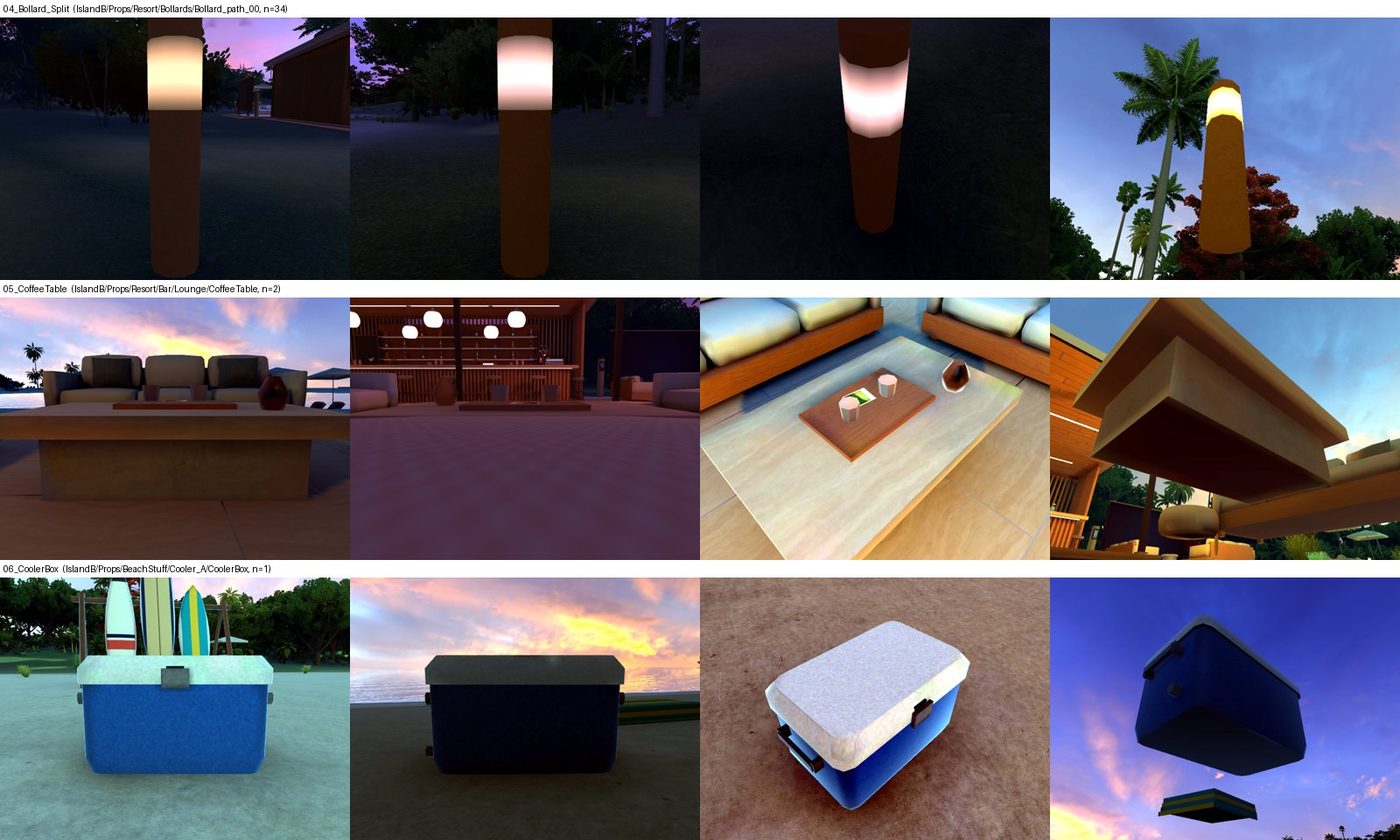
Part of a close-up sheet from a placement review of Crescent Lagoon: every distinct mesh, in place, from 0.5 m. That review returned NEEDS WORK, Style 6/10 and Build 5/10. The cups on the coffee table were one of its blockers.
The dressing-reviewer is the placement gate. It reviews whatever a build pass put in the scene, and how: placement, contact, facing, joints, scale in context, style and colliders.
When it runs
| Stage or mode | What it reviews |
|---|---|
| C.1 | structure passes, shell finish, the real furniture as placed, dressing |
| C.2 | the placed interaction objects, statically |
| CONCEPT PICK | ranks concept-art variants per area, when the owner leaves the pick open |
It runs in the open Unity scene, before the final bake.
What you give it
The orchestrator passes:
- the world brief path (
WORLD.md), - the stage (C.1, C.2 or CONCEPT PICK) and the exact target objects or area,
- the logged pass plan,
- the builder's z-fight scan and PropGate output for that area,
- concerns,
- the previous report, on a re-review,
- in C.1: the builder's furniture record and door-zone, spacing and LOD-ghost check output,
- the commit hash of the state to review,
- the model registry (
Design/assets_reviewed.tsv) and the findings ledger path.
Order of work
- Findings re-shoot. Every case of the findings ledger in its scope.
- Measured gate. It reruns PropGate, the registry check and the z-fight scan itself.
- Shots. Its own captures, every one opened.
- Judge. The design lock, the picked images, the seating and layout checklist, then 14 criteria.
- Report.
What it returns
A report with two scores, the measured tables (contact, overhang, facing), the list of floor-standing pieces, and a coverage line:
placed meshes looked at close up, in place: N of N distinct meshes
It also lists what it routes to other gates: model gate returns, notes for the material-reviewer, notes for the playtest-reviewer.
Verdict and score
- Two scores:
Style N/10 · Build N/10, each with its reasons. Both must be 8 or more for SHIP IT. - Its best verdict is "build SHIP IT". It covers the C phase only and does not sign the area off.
- SHIP IT also needs the coverage line at N of N, no model gate return, no ungated model, and no findings case in scope left open or reopened.
- Fewer than all meshes looked at caps the verdict at NEEDS WORK.
Main criteria
Measured, from its own PropGate run (see Unity checks):
| Check | Finding |
|---|---|
| Contact | float over 1 cm or sunk over 2 cm: should-fix. Float of 5 cm or more, or no support: blocker |
| Props resting on furniture or a table top | a gap over 5 mm: should-fix |
| Joints | a joint over its maximum gap: blocker |
| Generated meshes | a mesh with no model file that is more than one plain box: blocker |
| Particles | a particle renderer with no texture: blocker |
| Z-fighting | any pair larger than 4 cm² on a player-visible surface: blocker |
| Registry | a model with no SHIP IT row for its file as it is now: blocker ("ungated model") |
Judged from its shots and scene measurements:
- Style match. Each thing placed against the area's picked concept image, as same style, not a copy. A build that shares only the palette with its image is a blocker.
- Scale in context. Furniture is real-world size. A prop shrunk to fit a surface or to clear a check is a blocker.
- Orientation. A seat or front facing a wall is a blocker. Seats face their group within about 15°. Wall-aligned pieces are parallel to their wall within about 2°.
- Seating and layout. Door zones stay clear. A lone piece mid-floor, both gaps over 0.30 m, is a blocker.
- Dining and bar clearance. Behind a seated diner at least 0.81 m, bar stool pitch at least 0.61 m.
- Colliders. A collider on a small prop, a barrier collider, a tree without a trunk collider, or a seat station nobody asked for: blocker each.
- Lie-down fit. The lie-down box top sits within ±4 mm of the mattress or seat surface.
- Nothing hidden to pass. An object disabled, buried, scaled or re-shaded to clear a check row is a blocker.
What it never does
- Never judges a model's own quality. A bad model goes back to the asset-reviewer and counts as that gate's miss.
- Never judges material, shader and texture quality (material-reviewer).
- Never enters play mode. What runs belongs to the playtest-reviewer.
- Never says anything about lighting (final-reviewer). An object reading black is expected here.
- Never samples. Room-wide shots do not review a prop.
- Never compares positions, proportions or layout with an image.
- Never edits
WORLD.mdor anything in the scene, and cannot sign a world off.
Whose work it judges: world-builder.
Source: agents/dressing-reviewer.md.